Robin Dixon
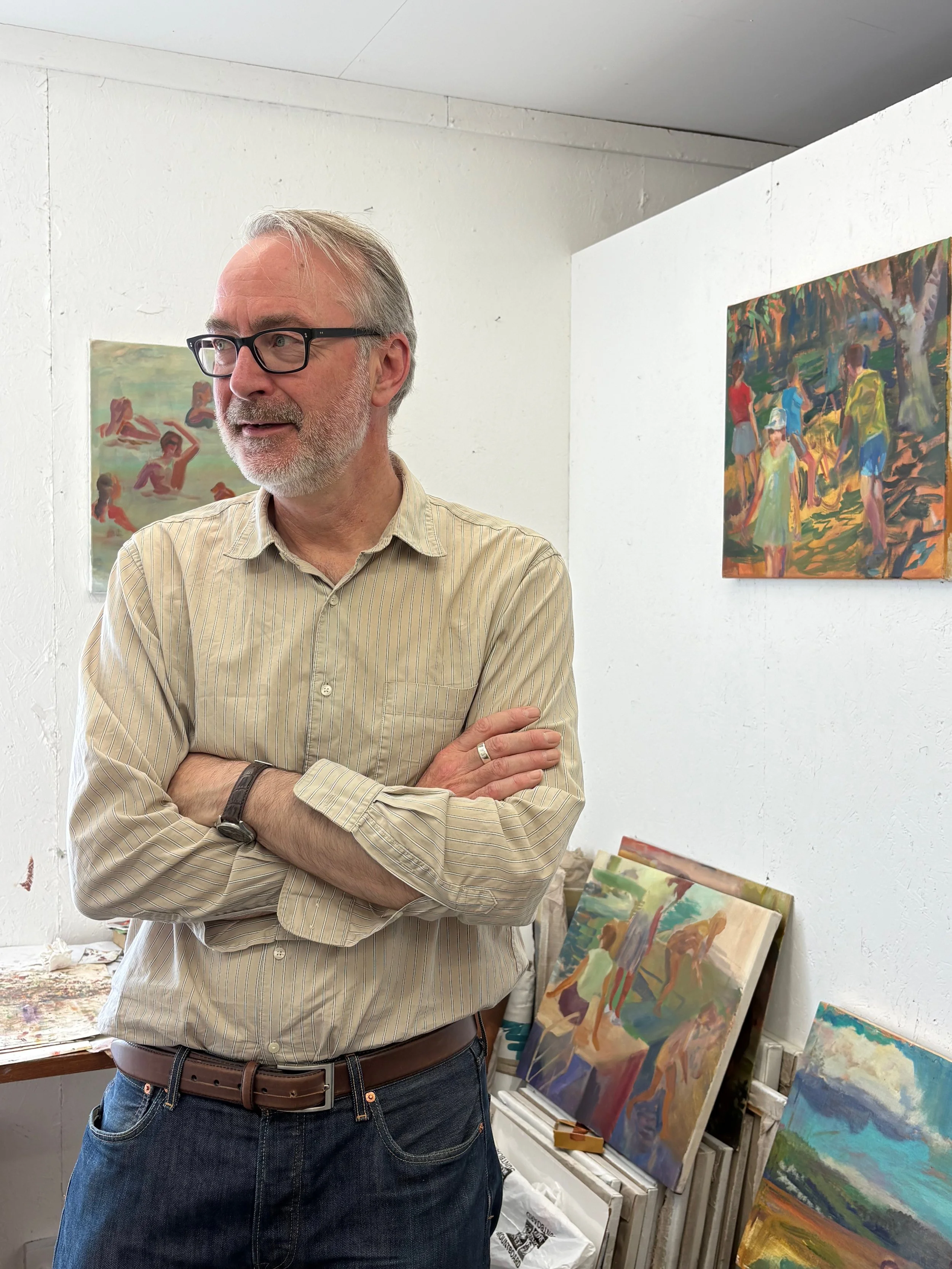

The Long Memory
Robin Dixon in conversation with Elliott Marsh
The show title is The Long Memory. I understand it’s a reference to an early 50s British crime thriller of the same name shot in Gravesend, where you now live. That phrase references revenge within the film. What does that title mean to you within the context of this exhibition?
It was coincidental, really. I'd never heard of the film, but I was at a private view at Lido Stores and I got chatting to Roy Eastland. I mentioned I came from Gravesend, and he started talking about this film he'd seen, which I'd never heard of.
Funnily enough, it happened to be on one of the streaming channels, and I watched it. It's actually a pretty good thriller, but what struck me most was the fact that it was very much to do with location. We moved to Gravesend nearly six years ago now, and I've always liked this area because I love the landscape — the marshes, the hills, the river. It was interesting in this film that a lot of the locations we're familiar with down the river were portrayed.
There's a really strange atmosphere sometimes when you're walking along the marshes, because it's quite wild. The further out you walk from Gravesend, the more desolate and interesting it becomes. It almost has a kind of prehistoric feel. And there's a connection with Dickens, obviously — Great Expectations is set very much on the marshes down here, and there are lots of weird and wonderful characters involved in that. There's also the fact that it has this ancient history; there's a lot of Roman history around this area. For some reason, that feel of the landscape ties in with this sense of history and imagining different times.
What's also interesting about the landscape around here is that you don't see a lot of people. It's quite sporadic — there are people working the land, people walking, a lot of birdwatchers. So when you do see figures in the landscape, it's quite striking. They're often quite memorable people, which is true of the film too: they're quite strong characters, and you can't quite work out why they're in this situation, in this place. There's one character in the film who's quite eccentric, a chap who works on the boats. He goes along collecting junk on the shore, and he's a quirky character who almost seems to spring out of the landscape itself. He looks like he's part of the river.
When Kristen asked whether I'd like to have a show, I thought about what I was going to show, what the angle on the work is. People have often said to me that there's a kind of timeless feeling to my paintings. I am strongly drawn to landscape and the feeling of landscape. This title struck a chord with me on different levels, because it's not just to do with historical memory, but also the memory of the painting. I work in layers, and quite often, underneath the surface of one of my paintings, you might see other paintings. So there's that sense of memory within the painting.
Memory itself is significant to a lot of your work. They're very evocative paintings, and very suggestive of particular scenes that often draw an emotional response, whether it's family holidays or social gatherings. The looseness enables the viewer to transpose their own memories onto the painting. Are you drawing on your own memories and experiences when composing a new painting, or are they predominantly based on other images and found images?
It's a mixture, really, because I'm a bit obsessive about looking for images and starting points, and different landscapes to walk through. I think it is this sense of looking for something, trying to recall something. Quite often I find images — photographs, mostly old postcards, and pictures in old books. They tend to be of particular periods, but there'll just be something about a group of figures that resonates with me. It clicks.
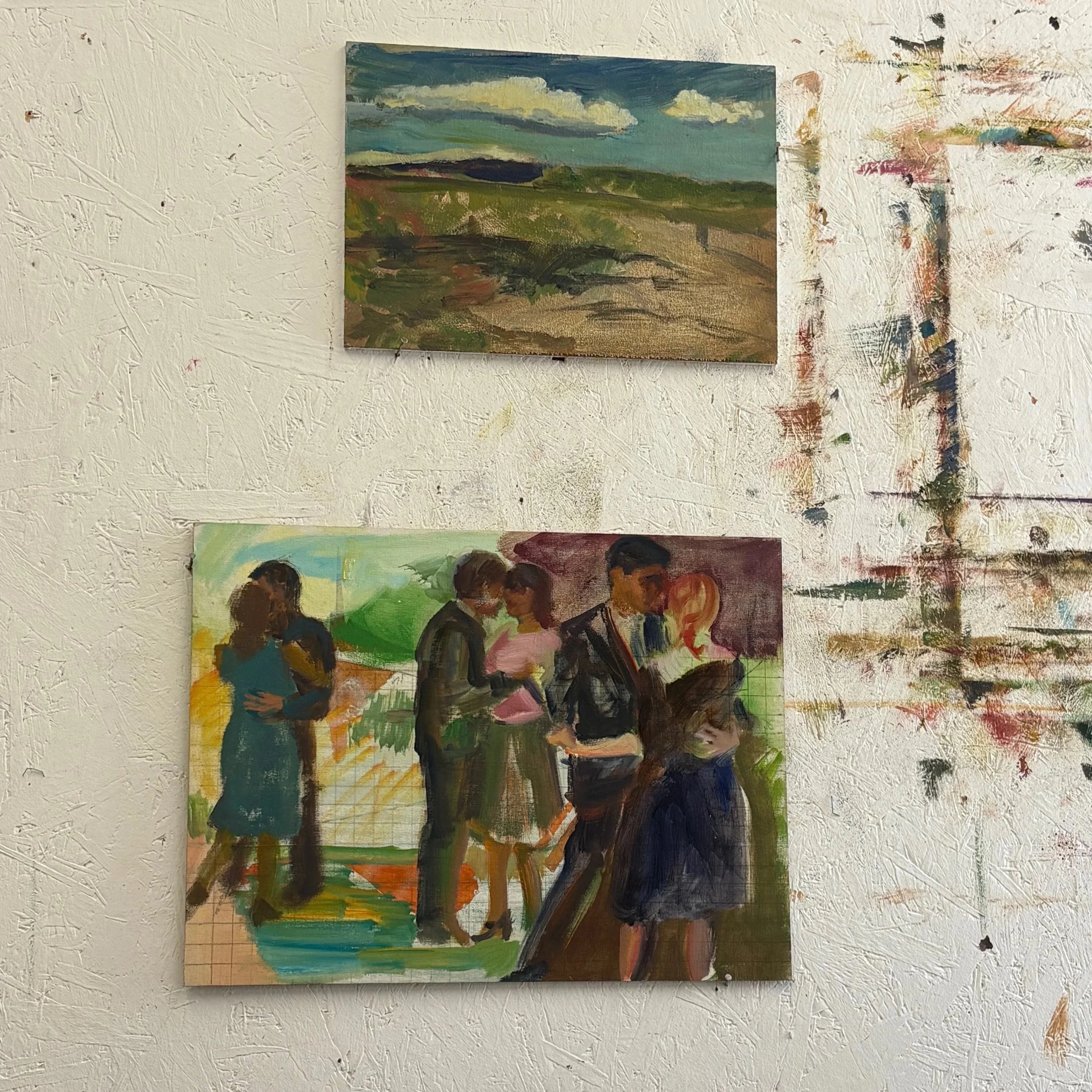
Quite often, to somebody else, they might be quite unremarkable. It might be what they're wearing, which reminds me of a certain fashion of, say, the 70s or the late 60s, when I was growing up, or just the odd combination of figures. Some of my paintings do bear a strong resemblance to the original image, but quite often they go off on a journey and incorporate other figures. I might get frustrated with a certain figure that's not looking right, and then introduce another figure from another source that clicks with the painting. I quite like that slightly subconscious gathering of information, and filtering it, and piecing something together. It's almost like solving a puzzle, where you think there's something missing from this painting, or it's just not generating a certain feeling — and then you might paint a figure out and replace it with something else, and suddenly it works in a different way.
When it comes to the preparation of a new painting — and you've alluded to the changing directions of a painting as you go — to what extent do you have a clear vision for where you want the piece to go before you actually start putting paint down? Is it an intuitive thing, or do you have a clear vision of what you want the end goal to be?
It's tricky, really, because sometimes I do and sometimes I don't. Sometimes I might start a painting thinking this is a really good start, I think I've got the composition right — and sometimes they'll arrive at something very satisfying quite quickly, which always makes me feel a bit uncertain; it's almost like it happens too easily. But other paintings I can really struggle with for a couple of years, and keep changing and painting over.
I've developed this strategy where I try not to think too much about what the end is. Sometimes I deliberately do a wrong start, or create an interference kind of background to paint into, to confuse me, so that it's not so easy to do a simple painting. It's hard to say, because every painting is individual. Sometimes a painting can work too easily, and I'll decide to scrap it and turn it upside down and paint another painting into it — and quite oddly, it can work, because I've created a space in the previous painting that works just as well with a new subject.
It's really interesting, that approach — being able to scrape back and paint over.It's like going back to the basics. It's almost like the figures in a painting become a distraction, and sometimes, if I lose the original figures, a space opens up and I start thinking about using a different combination of figures in the space. I suppose it's more about creating a space sometimes, or creating a convincing landscape. Quite often I'll have created a surface that's interesting, and then it's quite easy just to project a simple image onto it, and it looks very evocative, because there's this sense of a build-up.
There's a lightness to your brushstrokes. Is that indicative of the pace that you paint at — are you fairly light and swift in your movements, or is it more of a laboured process?
I tend to work pretty quickly. I think it's more that the time I have is quite choppy. I work in a bookshop four days a week, so that takes up most of the week, and I have odd days off when I can get in the studio and try to switch off from what I'm doing at work. I have this limited time, where I tend to work up to getting into the painting, and then work almost in a flash of inspiration for, say, an hour. But I quite often reach a point where I think it's working and I've got to leave it, because I'm going to spoil it.
Quite often I feel that if I paint something spontaneously, it seems more authentic, more truthful. The marks are more economical, more descriptive; they can just work in a simpler way. Whereas sometimes, if I don't get something right straight away, I have to keep correcting it and end up spoiling it. I like that spontaneity and economy of painting. But I will go back and work into it. It varies a bit.
On that note around spontaneity — to what extent are the finished paintings driven by the source and reference material, whether it's found photographs or whatever else you might be drawing on? Is the destination something you're conscious of and driving towards, or is it more of an intuitive meandering to get to the end result?
It varies from painting to painting. Sometimes I'll paint a background — say I've been out walking through the fields or through the woods, and I'll take some photos, and I'll think I want to use this space, but I don't know how I'm going to use it. I'll paint the landscape, and then think, I know, I'm going to put something in it. And then suddenly I'll think of something that will work. I plan in that way: I know I'm going to recreate this landscape or situation, and I know roughly what sort of figures I've got to put in, but I'm not exactly sure. It gets clearer the more I work on it.
Obviously, I try things out and they don't work, quite a lot, but that makes it interesting, because I just keep changing. I did a painting recently that had four figures standing by the river. I really liked one of the figures, but I knew there was something not right about them. It's only recently, after about a year or so, that I thought, I've got to get rid of these figures, even though I like them. Suddenly, with just the two figures in the middle of the painting, it worked in a completely different way — a completely different feeling. But it was very hard to make the decision just to paint something out. I think they call it killing your darlings.
You mentioned revisiting a painting after a year. How many different paintings would be in progress at one time? Do you tend to have a lot on the go at once, working on them little and often?
I have a lot of paintings on the go. If you came to my studio this afternoon, you'd see probably about 40 or 50 paintings stacked around. It's not that I'm working on them methodically. They're just sitting there, and suddenly, if I get fed up with what I'm doing, I'll drag something out that I've completely forgotten about and start thinking about what's wrong with it. I know all these paintings have got something in them. They won't all be finished, but it's a sort of gestation process, where you're mulling things over. Recently I've dragged out a few paintings from maybe 10 or 15 years ago that I'm going to paint over. I just don't know what's going to happen to them — whether I might chuck them away and get fed up with them.
I know some artists find it really difficult to go back to old paintings, or do anything with them. But I think it's partly the nature of how I paint them, that I leave them open-ended a lot of the time, so I can go back. I'm not tremendously good at finishing paintings, or at knowing when they're finished, but I've made that into a rule — that it doesn't matter. If I'm okay with it at that moment, then it's kind of finished. It means I can revisit paintings if I still find them interesting, if I don't know what to do with them.
When you look at those paintings from a decade ago alongside the works you're painting at the moment, how would you say your style has evolved over time, and how has your relationship with paint as a medium evolved over the years?
I hope there's more depth to the painting, really. I've noticed a lot of things. There was a certain time when I painted very flatly — things were almost, I don't know if it's the right word, quite graphic: flat areas of shapes and colour, slightly poppy in a way. I think you get influenced by things around you. At a certain time I tended to paint in an almost drawing kind of way. Now I tend to build up the paint more, and use more paint. And I think the colours have changed. I use a lot more definite colours, and interesting, unusual colours together. That's something I've really developed in my work. There's more clarity to them now. I don't know what other people think looking at them, but I think there's a clearer feeling and meaning to them.
It was interesting looking at your website and seeing bodies of work on different elements — you had the laboratory series, and a section of paintings of birds. Was that a conscious decision to focus on a particular subject, or were they linked to something else?
It's interesting, because I think sometimes, as a painter, you have this desire to paint, but you're not really sure what's important, or what you really want to paint. You just have this desire. With the laboratory paintings, again, it was to do with memory, because I focused on something about my dad. He was a chemist and mineralogist, and used to work in a lab where they quarried this stuff. When we were kids, he often used to take us in over the weekend, because he had something to sort out or fix in the lab. It's just a memory, but it was quite an interesting place, in this woodland, amongst these pine trees. This was in the 70s, so a calculator was the size of a typewriter in those days, and everything was fascinating, because it was all very alien to us. I picked up on this as a way of looking back and thinking about where memories come from — the specific things that you feel are important memories.
In parallel with this, I've always been interested in nature, the natural world, ecology, and science and industry. That's partly my attraction to Gravesend, really — this sort of industry, this town and countryside side by side. It's got all these different elements that are interesting. With the laboratory series, it was really something to focus on. At the same time, I was getting into the idea of looking for certain images and photographs, and I kept discovering these photos of people working in labs that were quite interesting. It's always about painting figures doing things, but sometimes it's hard to know how that fits into a painting, or what they're actually doing. Quite often I used to do paintings where people would say, "That's really interesting, but what are they doing?" So it was interesting painting these scientist figures in laboratories, because I felt like I had some sort of connection with that through my dad, but also with this idea of how science was idolised and idealised in the period when I was growing up.
I showed those paintings with Collyer Bristow’s — Rosalind Davis put on an exhibition, and I managed to show a few of them. It was interesting chatting to a guy who worked for the British Standards Institution, who used to give the kitemarks of British quality on products. He said these figures were all very nostalgic for him, because these were the people he was working with, who were developing products. He had the same kind of feeling about it being a different time, a different ethos almost — the idealism of the whole thing.
It is funny. Quite often I've felt like I've been searching for a subject, but it's more a combination of things. Now I feel quite happy, because I'm painting figures in situations, but trying not to worry too much about what they mean, and just painting them a bit more spontaneously. Quite often I now draw on photos I take myself, of people wandering about, people I know. So it's a real mixture.
As an offshoot of the comment about memories of time spent with your father and visiting the labs — how much of the work is autobiographical?
It can be sometimes, but it's not a conscious thing. Sometimes it surprises me how the paintings look, or what they turn out to be — "Oh, that's funny, that's a bit like a certain thing I remember" — but it won't be as literal as that.
For instance, I said in my statement [for this exhibition] about this idea of being in a gang and wandering around the countryside. When I think about it, I don't really think of myself as a gang person, but I suppose I spent a lot of my childhood wandering around in these sort of random groups of people, and that's just an experience I enjoyed, and something I draw on, even though it's not conscious. I'm not trying to depict this thing that happened, or these people I was with. It's more just a feeling.
For instance, there's this painting of three kids walking up to a quarry and peering over the edge. That's something I remember from when I was living on an estate in Milton Keynes. There used to be this bunch of kids in the street where I lived. I think the youngest was probably about five and the oldest about 12 — it's that classic thing where the kids all went down from tall to short. We used to go wandering off. We lived in farmland, basically, and we didn't know anything about footpaths or anything like that, so we just used to wander, and climb through fences. It was an adventure. We didn't know where we were going, but we'd find these things, and we'd all be peering over, looking at them. I think that painting evokes that sense of mystery and excitement of just exploring somewhere and not having any adults around. Probably quite dangerous.
When I was a bit older, I had a friend at school whose uncle had a farm. He used to take a ferret and go ferreting in this farmland, trying to get rabbits, and I used to tag along. This was in Milton Keynes, before it was becoming really built over. There was a little gang of us there, and we used to shoot a few pigeons and splash the blood all over us, that kind of thing. There was always something unpleasant going on, but it was kind of interesting, because we were there in the landscape, doing stuff.
When you started painting, do you feel that had a direct influence in the direction you took your practice in as a young painter?
I started painting fairly young. I was encouraged, really. My elder sister Claire used to paint, and my cousin also used to paint. It wasn't like we had a particularly cultured family, but there were elements of culture to it; my dad was really into his literature. I do remember, when I was young, I had a painting hanging up in my bedroom that my cousin had done of a pheasant, and I was fascinated with the oil paint. I didn't really know what oil paint was. It was on paper, and the paint was kind of stuck to the glass, and I just found the substance and the texture of the paint really interesting. And my sister used to paint, as I said, so I used to find her paintings very impressive — she was a lot older than me. I asked for some paints for Christmas, and I got this little box of oil paints, and I used to sit and paint at weekends in the kitchen and dining room. And from then I never really stopped painting.
It's funny — I don't think I was particularly good, but I used to quite enjoy doing it. And then gradually I got more and more into it. I used to like birdwatching and wildlife and stuff, so I used to paint birds and animals a lot when I was growing up. And I ended up going to Maidstone College of Art. When I finished school I went to Foundation in Northampton, which I really enjoyed, and then I ended up in Maidstone. Whilst I was at Maidstone doing my BA, I painted a lot in the countryside — I used to go out in the woods and fields around Maidstone and paint. I was always kind of drawn to painting landscapes.
What would you cite as the key turning points in your practice — whether educationally, through external influences, or your own independent decisions — and what directions did they take you in?
Like I say, I was always doing bits of painting through school and stuff. My older brother Nick particularly encouraged me; he really liked the fact that I did painting. He was quite artistic, and was involved in the ballet world and dance, and he was very encouraging. So that kind of kept my confidence up to keep going.
I eventually applied to the foundation at Northampton, which I really enjoyed. It was just a one-year foundation, and you'd get a couple of tutors there who were really good, and they'd just say things like, "Okay, today we're going to paint, but not using any brushes — you can only use cardboard and a stick." Pretty interesting, and completely challenging about making art.
And I got into Maidstone College of Art to do my BA. I found it difficult adjusting there, really — there were a lot more people. I didn't really know what I wanted to do there, or what I was doing, and I don't think I was a very good student, so I felt like I slightly wasted my opportunity there. Even though I ended up in the third year doing some serious, good paintings, with a good teacher — I was painting still lifes of dead birds and things like that, and plants and trees — and people seemed to really like what I did, I felt like I didn't really get what I was supposed to be doing there. I felt a bit lost. I think it was partly me being quite shy, which didn't really help.
But then, when I left college — me and Mandy, we've been together since college — we moved up to Bradford in Yorkshire, to help start up studios just outside Bradford, because an old college friend from Northampton had moved up there. I think that was really important, because it kind of kept the momentum going. Because I think after you graduate, you really feel like, oh, is that it? Am I going to carry on doing painting? Getting involved in the community out there — there were ceramicists and sculptors and all sorts, in this rundown old woollen mill just outside Bradford — that kept us going, thinking you can carry on doing stuff, even though you haven't got any money to buy materials.
And then we got a bit isolated living in Bradford, so we moved back to London eventually. We were lucky in that we got a landlord who rented a house out to us, and he was quite happy for us to paint in the front room, so we used the front room as a studio, which was really lucky. But again, we felt very isolated. I think the really important thing was moving into Bow Arts studios. It's probably become a huge empire now, but there were about 100 artists there, in these old factory buildings on the Bow Road. It was great being amongst all these other artists. We made some really good friends there, and started showing our work, and that was crucial. It gives you a bit of confidence, but you also become more aware of what's going on, what the zeitgeist is. You become more conscious of maybe trying to aim to produce work which you might get shown, or that someone might pick up on. I think that was really important for us.
Location is important, and not just in a social sense — it does influence the day-to-day practice. I'm interested in whether living in Gravesend for the last several years has markedly influenced the work, particularly things like the landscapes and the colour palettes, and whether you see that in the work now?
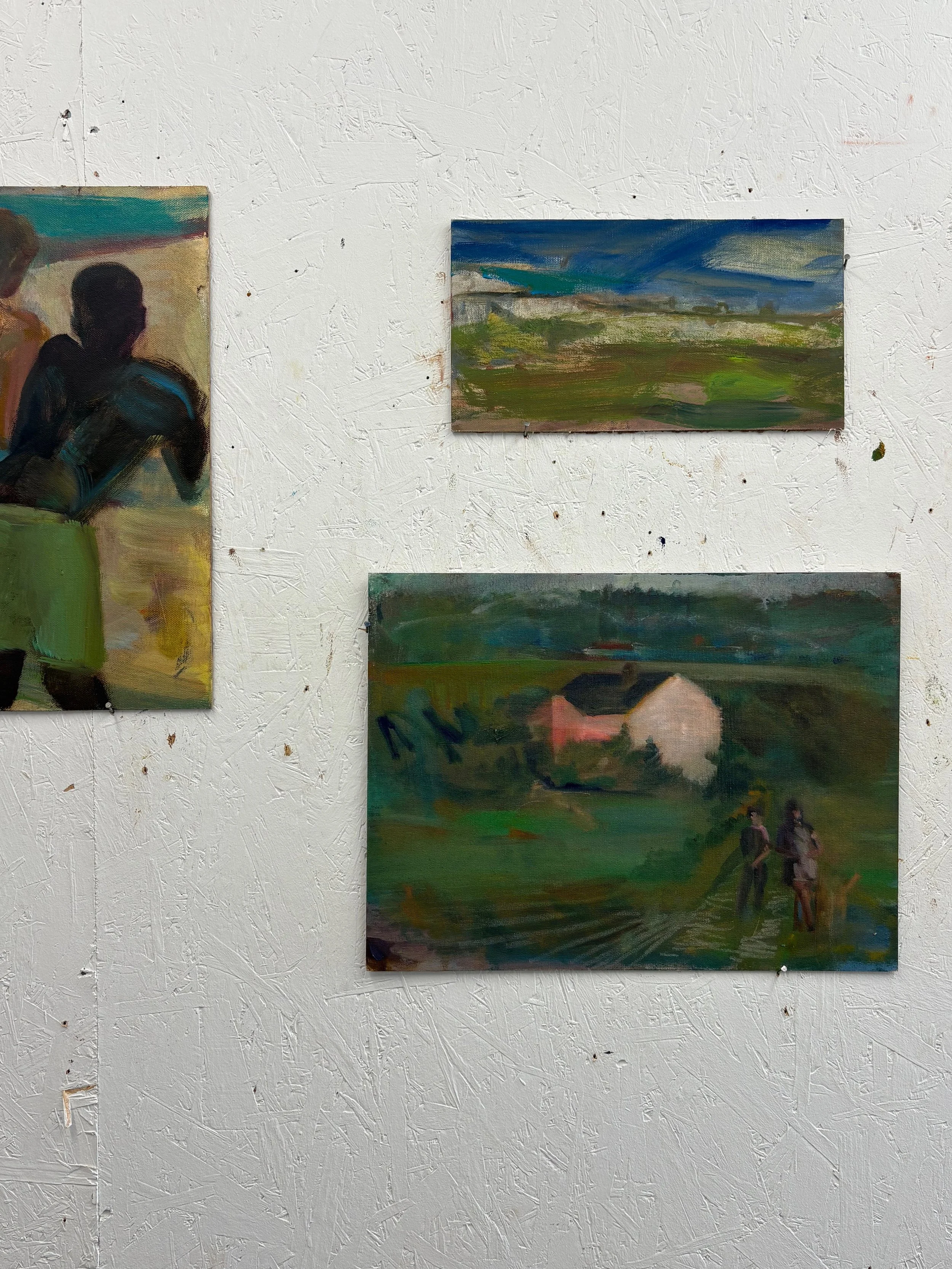
Yes, certainly. Looking through the paintings that I've put forward for the show, predominantly the landscapes are actual places, based on scenes around Gravesend or just a bit further afield.
Mandy and I moved here six years ago, and we've only got a studio here in the last couple of years. Before that we were both working in our spare room, which is quite a small room — we had to take it in turns painting in there, but we managed to do it somehow. What it meant was that, before, when I had a studio in London, I was doing some quite large-scale work — big paintings. Now I think, how on earth did I manage to do all these big paintings? What did I think I was going to do with them? They're all in our spare room. But what it meant was that I scaled down a lot, and I got into a routine of making these little panels, sticking canvas down, recycling canvas, and making my own panels to paint on.
Also, because we were painting at home, and this was during lockdown and stuff, I got into a routine of going for walks, wandering about, coming into the studio, and then painting immediately what I'd seen and what I'd photographed. I felt like there was a real connection with the experience. I'd never really done that before, where I'd come into the studio and paint what I'd just seen, and that was interesting. I think that's carried through now that we have got a studio. I like to keep that momentum going of going out, seeing things, and then almost trying to get them down as quickly as possible. And obviously a lot of local things, local scenes.
You've mentioned your day job. How do you balance the demands of that with studio time, and how often are you able to be in the studio?
I tend to get in the studio two or three days a week, I guess — just as often as possible, really. Quite often it takes a while to adjust to being in the studio. I can never just start painting as soon as I get in there; I have to go through this process of trying to relax. But I've just adapted to how to use the time by, like I say, having lots of paintings on the go and working quite quickly on each one, working in layers. It's just something I've developed over the years, which has created a certain way of painting — a style, I suppose.
When you're in the studio, do you listen to music or podcasts when you paint, or do you prefer to work in silence?
It's a bit of a mixture. I do often listen to music. I do like listening to driving, droning music, as a kind of comfort. I listen a lot to bands like The Fall, and Spacemen 3, and all this stuff I used to listen to. It's sort of comfort music — it's a kind of presence, quite often propulsive music in the background. But quite often, I know when I'm really getting into my painting, because the music stops and I just carry on painting with my headphones on and nothing coming out. I do quite often work in silence as well, but it depends what's going on in the building, because sometimes there might be a bit of distraction going on with noise, because it's above a factory.
They make wooden panels for artists in the factory downstairs. It's a bit like watching Eraserhead or something — you hear all these strange grinding noises, and sandblasting, and all this stuff. But music is quite important. I do listen to a lot of stuff that creates a certain mood. I have these go-to bits of music that I stick on to get the painting going.
You mentioned wanting to relax and get into the headspace. Do you have a particular routine that gets you into that space, every time you're in the studio?
It normally starts off with making a coffee and pushing a few paintings around. A friend of mine was saying it's quite good sometimes to have a painting that you're fiddling around with, just to play around with to start off. You need something that's not too challenging to get you started, something you're just playing with and doodling a bit on. But sometimes I'll just get a lot of paintings out and simply look at them, and start puzzling about where they're going.
Sometimes it can take a while before I get painting; sometimes I think of something straight away. It's all about decision-making, really, about whether what you're planning is going to work. I can suddenly get very frustrated with looking at something, and leap up and launch into it. It's normally that state of frustration — you feel slightly exasperated with looking at this terrible painting and how you can improve it. It's almost like you have to lull yourself into it. I feel like I have to treat myself into feeling relaxed.
How do you manage your time in the studio? And, as an offshoot of that, do you work better when there are time constraints, or do you prefer to have more flexibility, to let the day unfold in the way it will?
On my day off I normally have a free day to do what I like with, so I'm very lucky in that respect. I don't have a lot of distraction, apart from getting home and cooking Mandy's tea. I generally try to get in not too late — if I've got stuff to do at home, I probably get in about 10 or 11 — and then, like you say, the day will just unfold, and I try to stay as long as possible, until about seven.
I think I'm fairly disciplined like that. It's very rare that I won't do anything in the studio, or that I feel like I've not done anything useful. It probably explains why I've got so many paintings on the go. I'm pretty productive, and I don't generally have a block. I don't seem to struggle for things to paint at the moment, which is really good. I think it's because I've got so many different bits of source material floating around.
That's quite important — I spend a bit of time finding stuff, looking for images. I love going to flea markets, and just looking in old libraries and stuff like that for source material, just randomly flicking through, because quite often I'll find a really good image, or a group of figures, in the most obscure book. It's so unpredictable. We've got this really low-key flea market in Gravesend every Friday, and there are a couple of stalls there that do have some weird and wonderful things, so sometimes I'll fit that in. If I need something, I'll go and mooch around the charity shops, or go and look in the library. Harking back to your previous question, sometimes I feel like I'm looking for a certain thing that's going to solve the puzzle of this painting, that's going to make something happen. I sort of know what I'm looking for. It's weird, but I couldn't really tell you exactly what it is. And sometimes I might find it.
You mentioned that beneath the studio there's the factory, and that they produce panels for artists. What's your relationship like with different surfaces? Do you work on both canvas and wood with an equal amount of time and interest, or do you have a preferred surface?
I do various bits. I'm fairly experimental, in that I'll make my own surfaces. I was quite lucky, because I got a grant from Creative Estuary in Northfleet — this body that's trying to encourage artists in the area. Both Mandy and I got a grant, and I spent mine on some really good quality panels from the chaps downstairs at the studios. What was interesting is that they do canvas-stretched panels, or just panels which are wood and unprepared. So I got half and half, and decided to prepare my own panels. I did various things to them, and they all seem to have worked quite well.
What I like is not painting on the same old thing, because it's quite unpredictable how a surface reacts, and it can create the painting in a funny sort of way. It can really dictate how you're going to paint. Quite often I like stretching linen onto a panel using rabbit skin glue, and then priming it — that creates a really nice surface. But also, sometimes I just like working on a really smooth surface, something that's maybe a gesso panel, or something that I've just primed onto the wood. They're just interesting in different ways. The only thing with a smoother panel is that it's hard to build up — I do like building paintings up in layers and painting over them, and it's a bit more difficult to do that on the panel. But I still keep trying. I really like just trying different things out. Sometimes you know instinctively that this is not for me — that's very smooth, or too rough. I don't like painting on jute, like thick weave canvas, or anything like that.
In terms of that experimentation, there’s a really beautiful use of colour in the paintings. I'm curious as to what leads to the decisions around the colours that you would use within a particular painting; whether it's driven by the source material, or whether you're chasing something independent of that.
I suppose it's slightly a kind of emotional thing, in that it's to do with feeling. Colour is obviously a very personal thing, and I find it quite unpredictable how colours work, and when they do work in a certain way. I always feel really pleased when something odd happens with colour. The funny thing is, with a lot of the images I work from, I don't necessarily use the colour from the original image. I tend to alter the colours quite a lot, or just make them up, because quite often I'm using low-res, black and white images of things. And I do that purposely, because it makes me interpret the colour myself.
Have you found that your use of colour has evolved over the years?
Early on, when I was painting at college, I used to use a lot of clashing colours, and there wasn't a great deal of subtlety about the use of colour. It's something you develop; you kind of get more sensitive to it, and you just learn how. Layering colour is really interesting, and I think it's quite a difficult thing to do, especially with strong colours. But how colours react in unusual ways is not predictable. I find it very difficult to predict how colours are going to work. Quite often it will be by accident, or something I remember: this would look good next to that. Often it's mixing unusual colours together to get a slightly different sort of tonal quality to, say, greens, or a dark. I don't use black; I tend to mix dark colours and create a kind of muddy, murky black that isn't really black at all. It's sort of a mix.
You develop these funny rules. I've just developed them myself — you couldn't put them in a manual of how to paint. They're just sort of things I've made up, really. I'm not afraid to paint a shadow blue, or purple. And I find it interesting painting a sky. I don't know who said there's nothing more boring than a pretty face — I find there's nothing more boring than a blue sky. I find it really hard to paint a blue sky, so I have to be quite inventive with the sky colours I've seen. I kind of think, well, that sky looks quite green. It's quite interesting when you alter the colours of things that you take for granted. You think something is a certain colour, and the closer you look, it's not at all. So, I loosely interpret the colour to my own device.
With the paintings that you've exhibited at Lido Stores, they've tended to be of a smaller scale, but you work on larger canvases as well. How does the scale of a piece alter the method, and the decisions that you're making with the application of paint and colour?
I've always tried to do larger paintings, and I've always found it quite tricky painting on a larger scale. Since I've been painting a lot smaller, I've found it much easier to control, and obviously it's easier to use more paint on a smaller scale. The difficulty I have is knowing how much paint to use on a large painting, and I always have this worry that I'm just wasting it — if I get something wrong, I have to keep overpainting. The way I've developed of working is much easier on a smaller scale, but I do feel drawn to painting larger paintings, though what I have in mind now is much more modest.
I'm more cautious when I paint on a larger scale, and they have been working a lot better recently. I treat them much more like my small boards — I'm much more prepared to muck around with them. Whereas in the past I'd do a large painting and think, oh, that's a bold large painting, that's great, and stand back, and then not really know what to do with it, where to go with it, because it's more of an effort, I suppose. But I have got a few larger-scale paintings, and I think I'm building up gradually, since this way I've developed of using more paint and stronger colours. The larger paintings have got more of a success rate, really, because I'm thinking about it more strategically, I suppose.
Do you ever struggle with motivation, and how do you stay motivated?
I just always find painting interesting. It's quite fascinating, just out of the way of work. It's kind of endless, in that there are so many possibilities, and I'm always changing things and moving things. It's something I always look forward to. But there are times when I kind of think, what's the point of making all these paintings? But luckily I have people who are quite supportive — like you guys showing my work, which is really important — and people who are quite encouraging. I'm just always interested in painting, I suppose.
A final question, on a semi-related note. What would you say painting does for you as an individual? What’s driving you to continue to paint, and that drove you in the first instance to start painting?
I suppose it's something to do with making sense of the world, and feeling like you're controlling something, trying to find some sort of meaning. And when something works, and you feel like it clicks, it's just a really special feeling. When you've created something, it's kind of fulfilling. And it's interesting, because a lot of artists would tell you there's a lot of failure, and a lot of mistakes, and things you discard, and you often feel like, what am I doing? But it's those moments where you surprise yourself, and something comes from somewhere, and you don't know how it's happened. I just like that feeling. It's almost like you're not really in control of it, but something happens. You don't really want to think about the why, do you?!